
Blog Details
- Member
- December 15, 2025
Crowd Physics Unleashing the Power of Distributed Human Action
Crowd Physics
Unleashing the Power of
Distributed Human Action
CrowdPhysics refers to the
coordinated effort of a large, distributed group of individuals (the
"crowd") to perform real-world, physical tasks. It represents a
paradigm shift from traditional centralized logistics and labor models,
leveraging the existing mobility, local knowledge, and idle capacity of
individuals to achieve efficiency, scalability, and cost-effectiveness. This
document outlines the core concept, benefits, current practices, and a future
roadmap for CrowdPhysics,.
1. The Concept of Crowd Physics
At its heart, Crowd Physics
transforms individuals from passive consumers into active, contributing nodes
in a physical network. It's built on the premise that everyday citizens,
equipped with smartphones and motivated by incentives, can perform a myriad of
physical tasks far more efficiently and flexibly than dedicated, centrally
managed fleets or workforces.
Core Principles:
● Decentralization: Tasks are distributed across a broad network of
individuals, rather than concentrated in a central hub.
● Leveraged Existing
Capacity: Utilizes people's existing movements (commutes, errands) and
available time/resources (spare vehicle space, home appliances).
● Task
Micro-segmentation: Complex physical jobs are broken down into smaller,
manageable micro-tasks that can be easily understood and executed by
individuals.
● Technology-Enabled
Coordination: Mobile apps, GPS, and sophisticated algorithms are crucial
for matching tasks with available crowd-workers, providing instructions, and
tracking progress.
Crowd as a
Network

2. Benefits of
CrowdPhysics
The advantages of implementing
CrowdPhysics solutions are multifaceted, impacting businesses, consumers, and
even urban environments.
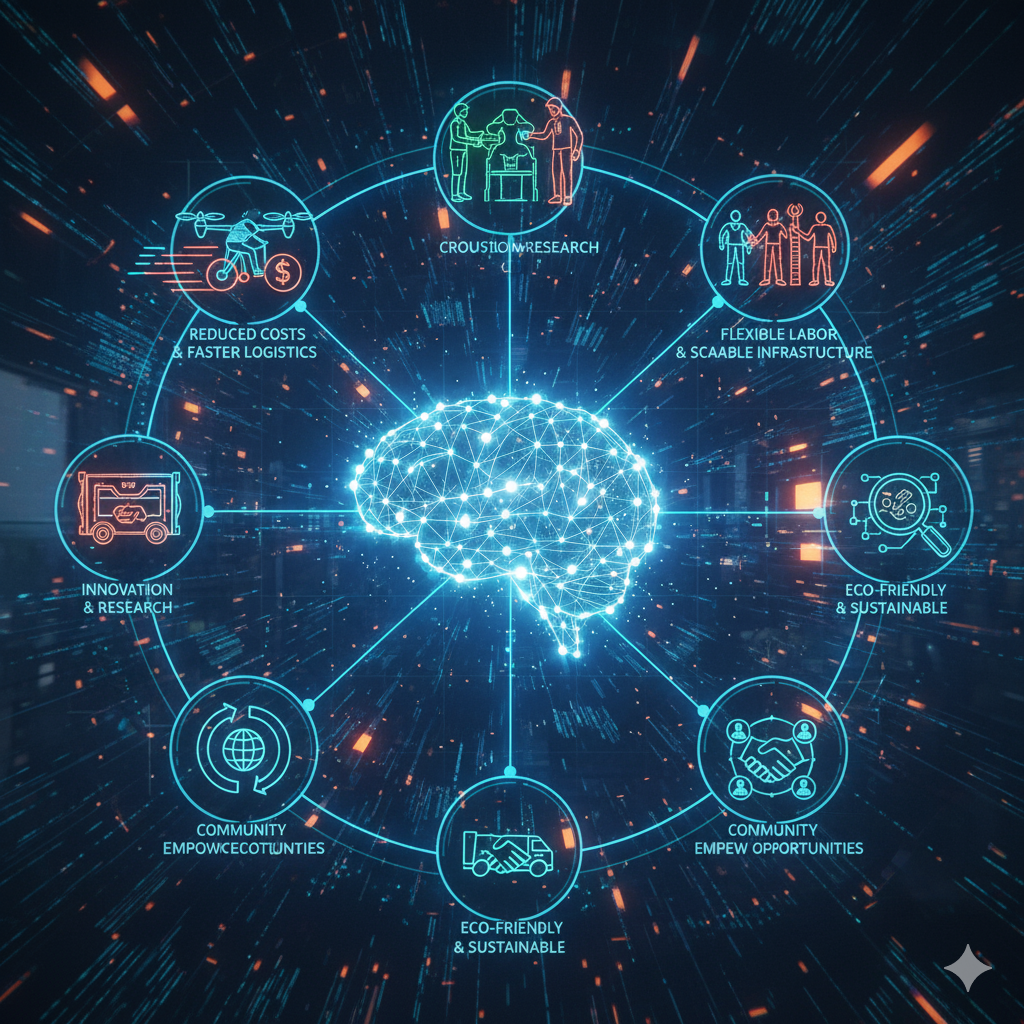
● Cost Efficiency: Reduces capital expenditure on fleets,
infrastructure, and full-time labor. Crowd-workers often operate at a lower
marginal cost, as they use their own assets (vehicles, time).
● Scalability & Flexibility: Businesses can rapidly scale up or
down their physical workforce based on demand fluctuations, without long-term
commitments. Ideal for seasonal peaks or unpredictable events.
● Speed & Responsiveness: Local crowd-workers can often complete
tasks (e.g., deliveries, emergency repairs) faster due to proximity and
immediate availability.
● Enhanced Customer Experience: Offers greater convenience (e.g.,
specific pickup/delivery times, hyper-local services).
● Environmental Sustainability: By leveraging existing trips (e.g.,
for deliveries), it can reduce overall vehicle miles traveled, fuel
consumption, and carbon emissions. ● Economic
Opportunity: Provides flexible income opportunities for individuals,
enhancing local economies.
3. Current Practices & Feasible Applications
CrowdPhysics is already
transforming several sectors. Here, we delve into areas where its application
is highly feasible and currently active, illustrating with relevant images.
3.1. Crowd Logistics (Crowdshipping & Reverse Logistics)
Concept: Utilizing
non-professional individuals to transport goods for the "last mile"
(delivery to consumer) and the "reverse last mile" (collection from
consumer for returns, recycling). Current
Practices:
● Last-Mile
Delivery: Food delivery platforms (Uber Eats, DoorDash), grocery delivery
(Instacart), and even some retail giants (e.g., Amazon Flex) rely heavily on
crowd-workers.
● Reverse Logistics (Returns): Emerging services allow customers to
schedule pickups of returns directly from their homes by crowd-shippers,
streamlining the return process. ● Parcel
Forwarding: Platforms enable individuals traveling internationally to carry
packages for others, bypassing traditional shipping costs and customs
complexities.
Crowd Logistics in Action

Concept: Mobilizing a
network of users to actively search for and report lost items, or to perform
localized physical checks and verifications.
Current
Practices:
● Smart Trackers: Devices like Apple AirTags or Tile rely on vast
crowdsourced networks of smartphones to passively detect and report the
location of lost items.
● On-Demand Verification: Businesses use crowd-workers to verify
physical addresses, audit retail displays, or collect real-time data from
specific locations (e.g., checking competitor pricing).
● Citizen Spotting: Apps for reporting lost pets or community safety
alerts often leverage local networks to keep an eye out.
Crowd-Powered
Lost & Found

3.3. Temporary Facilities
& Event Infrastructure
Concept: Utilizing a
flexible, on-demand workforce for the rapid setup, operation, and takedown of
temporary structures and services for events, exhibitions, or pop-up retail. Current Practices:
● Event Staffing: Platforms connect event organizers with local individuals
for roles such as registration, ushering, setup/teardown of non-complex
elements (chairs, tables, basic decor).
● Pop-Up Store Assembly: Companies hire local taskers for quick,
modular assembly of display units and fixtures for temporary retail spaces.
● Festival Logistics: Volunteers and paid crowd-workers handle tasks
like waste management, signage installation, and basic site preparation.
Crowd-Enabled Event Setup

3.4. Crowd-Laundry
Services
Concept: Connecting
customers who need laundry done with individuals who perform washing, drying,
and folding services using their own equipment, often with pickup and delivery.
Current Practices:
● Local Laundry Services: Several apps and platforms facilitate
peer-to-peer laundry services, offering convenient, often next-day, clean
clothes without the customer leaving home.
● Specialized Garment Care: Some services extend to dry cleaning
drop-off/pickup or basic mending, utilizing a distributed network of local
specialists.
Crowd-Powered Laundry

Roadmap for CrowdPhysics
The evolution of CrowdPhysics
will be driven by advancements in technology, a deeper understanding of human
coordination, and evolving societal needs.
4.1. Enhanced Coordination & Automation
● AI-Powered Task Orchestration: More sophisticated algorithms will
predict demand, optimize task allocation based on crowd-worker location,
skills, and even mood, and dynamically adjust incentives.
● Edge Computing & IoT Integration: Smart devices and IoT sensors
will provide real-time environmental data (e.g., traffic, weather, event
status) to enhance task planning and execution. Drones could potentially
support inventory checks or aerial monitoring.
● Augmented Reality (AR) Guidance: AR overlays in smart glasses or
phone apps can provide step-by-step visual instructions for complex physical
tasks, making intricate assembly or specialized repairs accessible to a broader
crowd.
AI-Powered
Coordination
4.2. Specialized &
Complex Tasks
● Micro-Manufacturing & Distributed Assembly: Breaking down the
fabrication of modular products into tasks performable by local crowd-workers,
fostering hyper-local production.
● Infrastructure Repair & Maintenance: Crowdsourcing the physical
inspection and minor repairs of urban infrastructure (e.g., street furniture,
bike paths) where immediate intervention is feasible.
● Decentralized Warehousing & Fulfillment: Utilizing network of
individual homes or small commercial spaces as micro-warehouses, managed by
local crowd-workers for ultra-fast local fulfillment.
Crowd-Assisted
Infrastructure Maintenance
Crowdsourced Reverse Logistics Service
The service
model is designed to make the collection of packaging waste a communal,
rewarding, and seamless process, transforming waste into a valuable resource
within the circular economy. The core physical task is the collection
and initial aggregation of specified, clean, and segregated packaging
materials (e.g., specific e-commerce boxes, reusable containers, or multi-layer
plastic). A digital platform will
manage the crowd, tasks, and incentives.

What sectors can benefit Cities are increasingly constrained by congestion, rising service costs, fragmented labor markets, and underutilized human capacity. At the same time, urban populations possess immense latent physical capability—daily mobility, local knowledge, time gaps, and situational awareness—that remains largely untapped by conventional centralized systems. CrowdPhysics unlocks this dormant capacity by converting citizens into distributed, incentive-aligned operational nodes. The industries that benefit most are those where physical presence, last-mile action, variability of demand, and local trust are decisive factors.
Urban logistics and last-mile delivery emerge as the most immediate beneficiary. Cities struggle with inefficient freight movement, redundant delivery fleets, and peak-hour congestion. Crowd Physics enables parcel movement, hyperlocal transfers, reverse logistics, and micro-warehousing using citizens already moving through the city. This dramatically lowers cost per delivery, increases resilience during disruptions, and scales organically with demand. E-commerce, local retail replenishment, and intra-city B2B logistics gain faster fulfillment without expanding vehicle fleets.
Municipal services and urban maintenance represent another high-impact domain. Tasks such as waste segregation monitoring, reporting of infrastructure damage, streetlight checks, water leakage detection, parking enforcement, and cleanliness audits are labor-intensive and poorly scaled under traditional models. Crowd-based physical reporting and micro-actions enable cities to achieve continuous coverage at a fraction of the cost, while increasing civic participation and accountability. This shifts cities from reactive maintenance to predictive, citizen-assisted governance.
Healthcare access and public health operations benefit significantly, especially in dense or resource-constrained cities. Crowd Physics enables medicine delivery, sample transport, wellness checks for elderly populations, follow-up visits, vaccination mobilization, and emergency response assistance. Local residents, already embedded within communities, outperform centralized systems in speed, trust, and reach—particularly for preventive care and chronic disease monitoring.
Urban mobility and transport support services gain efficiency through distributed human participation. Crowd-enabled traffic reporting, first- and last-mile connectivity, informal para-transit coordination, parking availability signaling, and EV charging assistance reduce friction across the mobility ecosystem. Rather than expanding infrastructure, cities amplify utilization of what already exists—people, roads, and time.
Retail, informal markets, and local commerce benefit by restoring competitiveness against large centralized players. Crowd Physics supports neighborhood inventory movement, assisted shopping for elderly or digitally excluded populations, pop-up market logistics, and rapid restocking. This strengthens local economies while reducing dependency on large distribution centers.
Construction, real estate, and urban development also gain through crowd-enabled site monitoring, material movement, inspection assistance, progress documentation, and safety reporting. Instead of maintaining large on-site teams, developers tap local availability for time-bound physical tasks, improving transparency and reducing delays.
Disaster response, climate resilience, and environmental monitoring are structurally suited to Crowd Physics. Flood reporting, heatwave assistance, tree-fall clearance, emergency supply movement, and early warning validation depend on speed, locality, and adaptability. Distributed human networks outperform centralized systems during extreme events when formal infrastructure is stressed.
Education, skilling, and community services benefit through physical facilitation—exam logistics, device distribution, community tutoring, library circulation, and campus operations—particularly in cities with large student populations. Crowd-based facilitation reduces institutional overhead while expanding reach.
Finally, cultural, tourism, and event industries benefit by using crowds for guided experiences, event logistics, local storytelling, maintenance, and visitor support. This enhances authenticity while lowering operational costs.
Across all these industries, the common thread is clear: Crowd Physics thrives where tasks are physical, localized, variable, and trust-dependent. Cities that adopt this paradigm move from capital-heavy, fleet-driven, centralized operations to adaptive, human-scaled, resilient systems. The result is not just efficiency, but a redefinition of citizens—from service recipients to active co-creators of urban functionality.